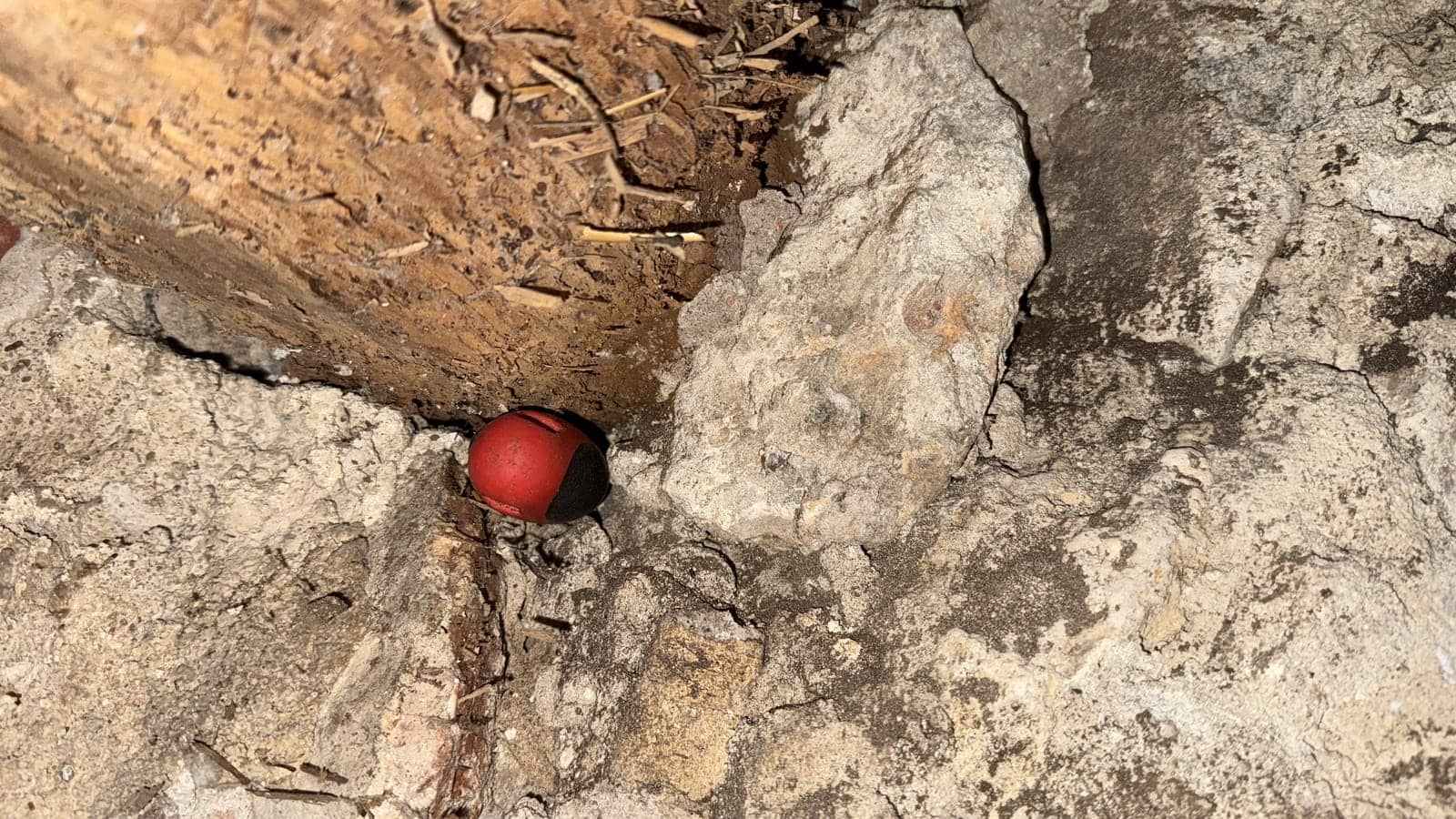
Fine, light frass under the beam
A small pile of dust the colour of fresh wood under a hole, reappearing days after you clean it. That is the activity marker. Holes alone can sit there for forty years without a single live insect left.
In Girona's old town a beam is not replaced without justifying it. Our job is to make that unnecessary: we treat the piece, keep it in place and hand you the floor plan with the condition of every one.
Visual assessment visit included, at no cost and with no obligation. The technical study with audiotermes, which confirms every point of damage, is quoted separately and you decide with the figure in front of you. We work Monday to Saturday.
Request your no-obligation visual inspection
We reply within 24 hours.
We serve the provinces of Barcelona and Girona.
* Required fields
In Girona's old town, replacing a beam is not only the owner's call: Decree 2295/1967 declared a 34.2 hectare area a historic ensemble, and within it removing a structural element must be justified before the administration. That is why woodworm here is treated conserving the piece: stripping if there is a coat on top, injection with non-return valves and double fumigation. It is not a preference of ours, it is what fits the protection.
In the Barri Vell the protection does not stop at the facade: it reaches the whole building, floor structure included. The usual build is stone wall with exposed beams and infill, often under layers of limewash or old paint. And that coat deceives: from outside the beam looks whole, so it has to be probed and listened to with audiotermes, because looking is not enough.
In the Mercadal and the 19th-century buildings the joists hide behind false ceilings. Woodworm gives itself away by the frass falling through a joint, or by the joinery: doors, frames and floorboards with holes of one to two millimetres. When the piece allows it, injection is done from the access hatches, without dismantling the false ceiling, and every treated beam keeps its number on its floor's plan.
In roofs and attics the one that truly compromises the beam is the longhorn beetle. Its larva, that of Hylotrupes bajulus, digs mostly in the sapwood, and the technical document on wood-boring insects by Juan Sánchez Soria counts it among the greatest enemies of construction softwood. It can be told from common woodworm with the naked eye: oval galleries, much larger, demanding considerably more product per piece.
Zone by zone, what was built, what wood sits inside and where the insect gets in. It is the reading our technicians make before deciding where the check starts.
| Zone of Girona | Dominant construction | Wood present | Way in | First sign |
|---|---|---|---|---|
| el Barri Vell | Stone wall with exposed beams and infill | Floor beams, staircases and inner galleries | Exposed wood under limewash or old paint | Frass on a step that gets cleaned daily |
| el Mercadal | 19th-century apartment building | Joists hidden behind false ceilings and joinery | Doors, frames and floorboards without preservative | Fine dust falling through the ceiling joint |
| Pont Major | Terraced home outside the walls | Joist floor structure and indoor joinery | Indoor wood never treated | New holes on the wooden window sill |
Source: ERRADICAT technical criteria from own work in the province of Girona · retrieved on 4 September 2026.
34.2 ha
of protected area in Girona's historic ensemble
Source: Decree 2295/1967, of 19 August
1967
the year Girona's historic ensemble was declared by decree
Source: Spanish Official State Gazette no. 224, of 19 September 1967
120-CH-ZA
code of the ensemble's cultural asset of national interest
Source: Inventari del Patrimoni Arquitectònic de Catalunya
3
larval-cycle wood-borer species of economic importance in Spain
Source: Technical document on wood-boring insects by Juan Sánchez Soria
How it was counted: we cite the rule as it stands: the decree with its signing date and the gazette where it was published. It is not a pending file, it is a firm declaration, and the hectares are those the decree itself delimits.
Girona's old quarter is declared a historic-artistic ensemble by Decree 2295/1967, of 19 August, and the protected area covers 34.2 hectares.
The protection changes who decides about your floor structure. Removing a beam inside the ensemble must be justified before the administration; keeping it, treated and in place, requires no procedure. That is why in Girona the floor-by-floor plan with the condition of every piece is worth as much as the intervention itself: it is the paper with which the owner and the architect defend that the wood stays.
Almost everyone arrives looking at the holes, and the hole is the one thing that says nothing about activity. These three do.
A small pile of dust the colour of fresh wood under a hole, reappearing days after you clean it. That is the activity marker. Holes alone can sit there for forty years without a single live insect left.
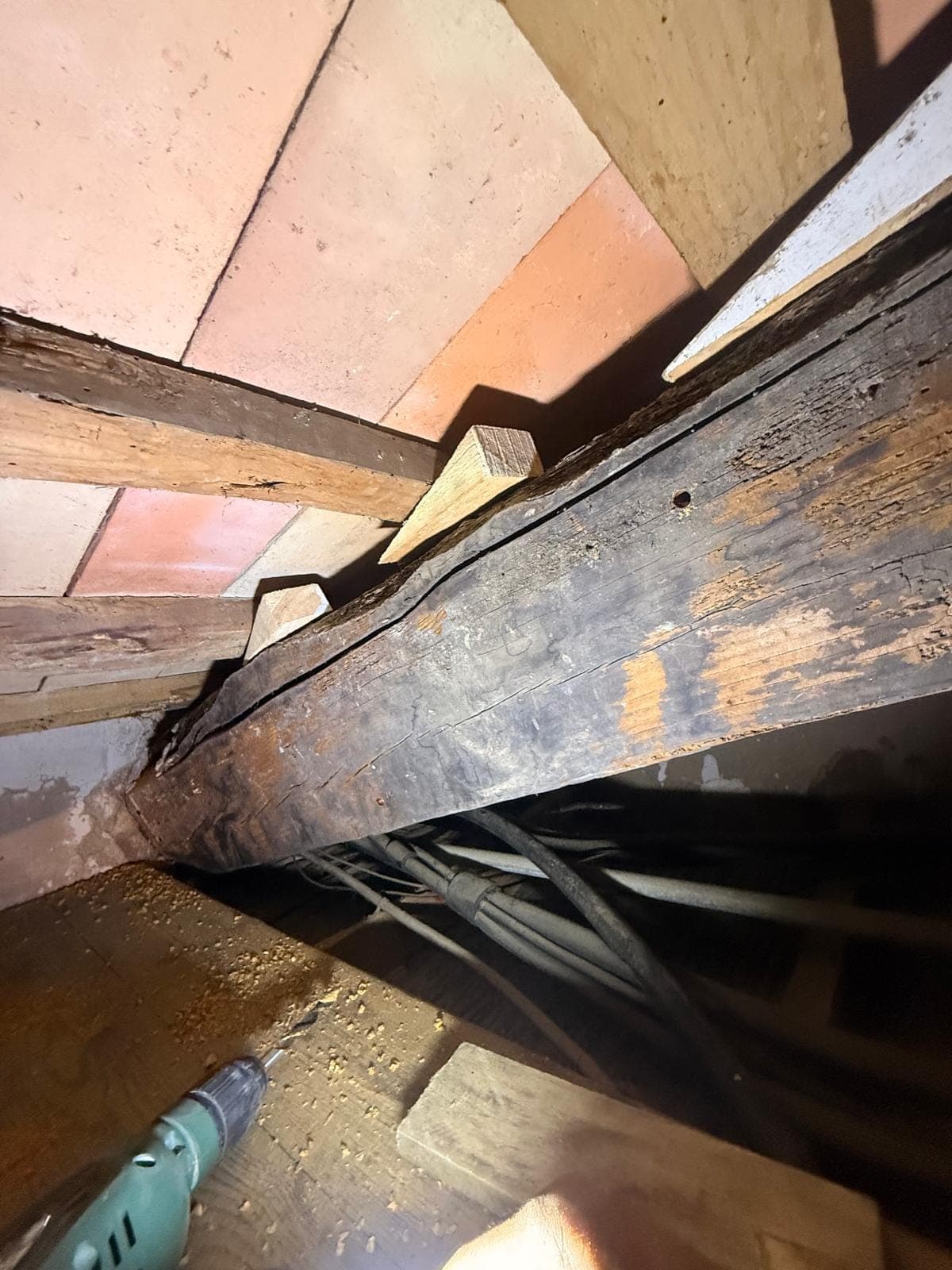
The diameter and shape identify the insect. Round and small points to common woodworm. Oval and several millimetres wide points to the longhorn beetle, the house borer that genuinely compromises a beam's section.
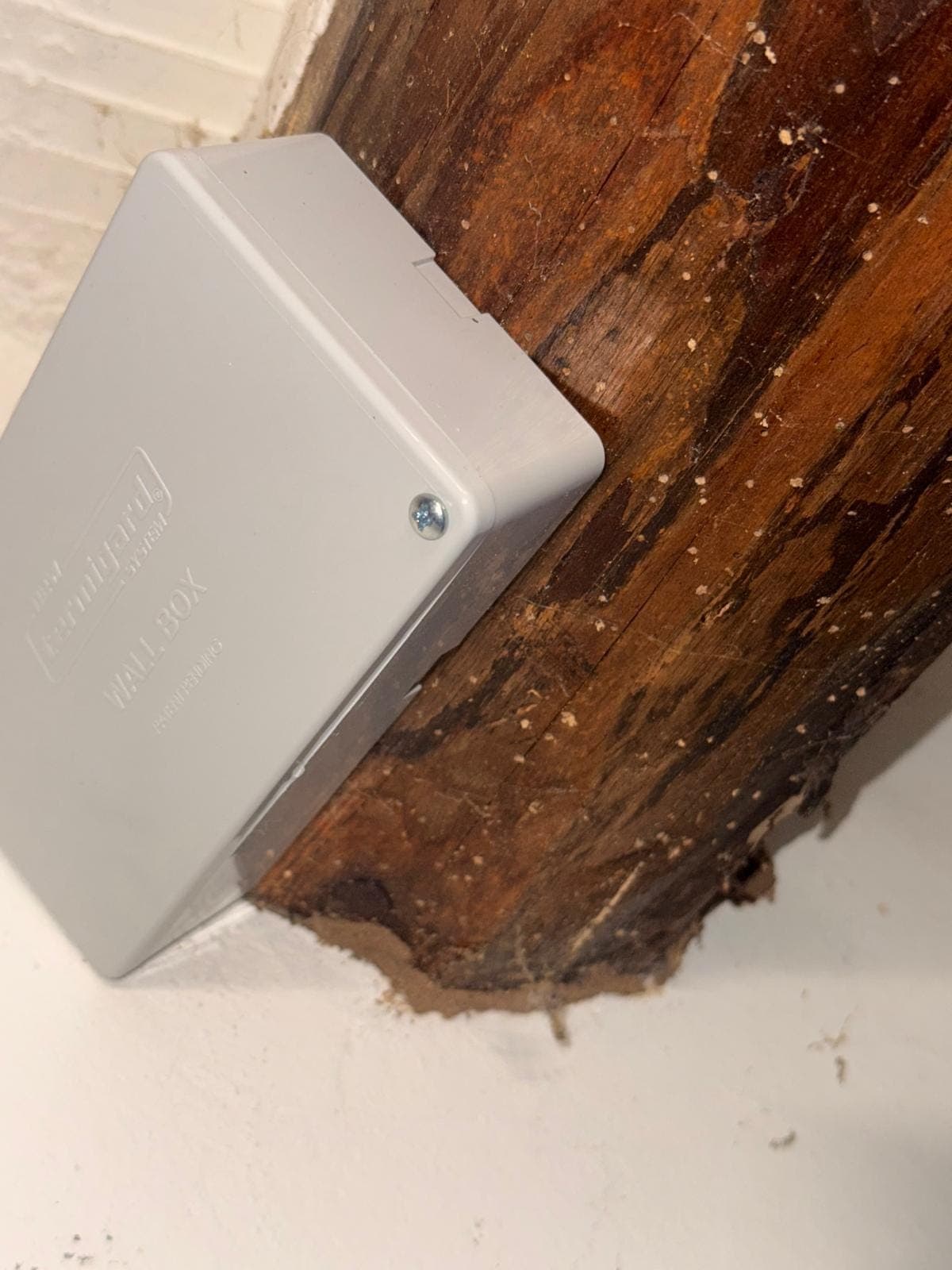
In a calm house, above all at night and in spring, you can hear a very fine scraping inside the wood. The audiotermes amplifies that sound and locates the exact piece, which is what makes it possible to treat where treatment is due.
Adult woodworm beetles emerge in spring, and in the occupied homes of the Barri Vell the clue usually comes from frass on a piece of furniture or a step that gets cleaned every week.
Common woodworm Anobium punctatum
Activity: from April to August · Peak: May and June.
House longhorn beetle Hylotrupes bajulus
Activity: from June to August · Peak: July.
These dates are indicative windows. Flight depends on temperature and humidity, so each year it starts earlier or later: if you see winged insects outside these months, it is still a reason for an inspection.
Source: Higiene Ambiental, technical journal of the sector · retrieved on 21 July 2026.
First the wood is read. Inspection with audiotermes, identification of the insect and assessment of whether the piece can take a curative treatment or has already lost load-bearing section and must be reported for replacement. If there is varnish, paint or limewash on top, it is stripped first: through a sealed coat the product does not get in.
Then comes the injection. Small-diameter holes are drilled at regular intervals, non-return valves are fitted and the wood preservative, a TP8-type biocide, is injected under pressure to reach the internal galleries. The UNE-EN 351 standard grades penetration from NP1 to NP6, and on a structural beam the target is the high classes, not a surface coat.
It closes with a double fumigation in two coats over the whole visible face of the piece, to cover what the injection cannot reach. And when the piece cannot be drilled, like a piece of furniture, a carving or a demountable coffered ceiling, there is anoxia: the piece is sealed in an oxygen-free atmosphere until the insect's cycle completes, without touching the finish.
Woodworm is solved on site, not over months of monitoring. The calendar depends above all on the metres of beam and on whether stripping is needed.
Total duration:In phases, without dismantling the floor structure or the infill
Included
A naked-eye walk along the accessible wood to see the apparent extent. The assessment visit is included, at no cost and with no obligation, and it is the starting point when the signs are unclear.
1 working day, with the figure agreed first
Percussion sounding, listening with audiotermes, identification of the insect and piece-by-piece measurement of the linear metres of beam. We always recommend it: it confirms every point of damage and marks which pieces need treating. It is quoted separately, so you see it with the scope in front of you and it starts when you say yes.
A few days later
Floor-by-floor plan with every beam numbered, its damage and the treatment proposal with your written quote. The work is measured by linear metre of beam counted on site, not by square metre of home. It is part of the technical study.
Only if there is a coat on top
Manual removal of limewash, paint or varnish in the areas to be treated, without harming the wood. Without this step neither the inspection nor the product penetration is reliable.
By floor or by room
Drilling, fitting of non-return valves and pressure injection of the wood preservative into the galleries.
Same day as the injection
Two coats over the whole surface of the piece, including accessible faces and edges.
As per the product data sheet
Waiting time before reoccupying the room. It is stated in writing in the intervention report.
The visual assessment visit is included, at no cost and with no obligation: when the signs are unclear, it is the way to clear doubts. Even so, we always recommend the technical study with audiotermes, a floor plan of the issues found and a report, which is quoted separately: it confirms every point of damage, fixes where the treatment must act and from it comes your written quote, so you decide with the figure in front of you.
Source: ERRADICAT's intervention protocol · retrieved on 4 September 2026.
It is not a decision closed between the owner and the builder. The building sits inside the area of Girona declared a historic ensemble in 1967, and removing a structural element is processed before the city council with technical documentation to justify it. That is why the report with the floor plan and each piece's degree of damage is produced before touching anything: it is what makes it possible to defend what stays and what goes.
Yes, and in the Mercadal of Girona that forces inspecting neighbour by neighbour before quoting anything. A joist resting on two load-bearing walls serves two homes, so treating only one flat leaves half the piece without product. What we deliver is the floor's plan with every joist identified and its degree of damage, to know which stretches remain pending access and in what order they get covered.
Yes, and in the roofs and attics of Girona's old town it is the first suspect, because the softwood the larva prefers dominates there. The sound is heard in silence, above all at night. With the audiotermes it is amplified and the exact piece located, so whether the activity is still live is confirmed without opening the beam.
Yes, as long as there is a way to reach the wood: access hatches, service openings or an accessible stretch of joist. It is how we work in the older flats of Girona: injection is done from there and completed with fumigation of the surfaces in view. If there is no access to the piece, we say so before starting rather than treating what shows and calling the floor structure solved.
Yes, before the renovation covers the floor structure. With the wood in view it can be read piece by piece and the report with the plan delivered, which the architect needs to decide what to keep, what to treat and what to remove. Doing it afterwards means lifting freshly laid finishes, and in a protected building every added action is one more justification to write.
In Girona we cover the whole municipal area, including el Barri Vell, el Mercadal and Pont Major, and we also reach Salt, Sant Julià de Ramis and Quart. We work Monday to Saturday, 7:30 to 22:00.
In the same city and the same wood, the doubt that usually follows woodworm is the subterranean termite: another insect, another way in and bait stations instead of injection.
Termite company in Girona, with checks every 6 to 8 weeksThe woodworm that in Girona is treated under the protection of the historic quarter shows up in Calonge in the beamed ceilings of the old town: that is where the case that measured that floor structure piece by piece lives.
Woodworm treatment in Calonge i Sant AntoniGirona is not the only woodworm location with its own page: in Roses the reference comes from Cadaqués, with the house's timber measured element by element and the treatment planned by injection.
Woodworm treatment in Roses: live activity, not old holesEach municipality has its own page, with real work from its area and the detail of how we work there.
Most popular municipalities
The technician who signs the reports, Head of Specialists at ERRADICAT, has been treating termites and woodworm in Barcelona and Girona since November 2011, holding the biocide applicator licence. Visits are always made by our technicians, never by salespeople.
The conditions and timescales go in the intervention report, signed. For termites, 3 years from the certificate of colony elimination, with the annual inspection included at no added cost.
The technical study ends in a floor-by-floor plan of the property, with the issues found marked and the real extent of the damage. It is quoted separately and the document stays in the owner's hands, to work with the architect or to seek a second opinion with data on the table.
Content of this page reviewed by our technicians on 4 September 2026.
We ask what you have seen and where. If the signs are unclear, we book the visual assessment visit, which is included and takes little time. And when the signs are there, what we recommend is the technical study: audiotermes, a floor plan of the issues found and a report, with your written quote so you decide with the figure in front of you. If the wood is healthy, we tell you that too: you save yourself the treatment.
602 433 979The visual assessment visit is included, at no cost and with no obligation: when the signs are unclear, it is the way to clear doubts. Even so, we always recommend the technical study with audiotermes, a floor plan of the issues found and a report, which is quoted separately: it confirms every point of damage, fixes where the treatment must act and from it comes your written quote, so you decide with the figure in front of you.
We serve the provinces of Barcelona and Girona.
* Required fields