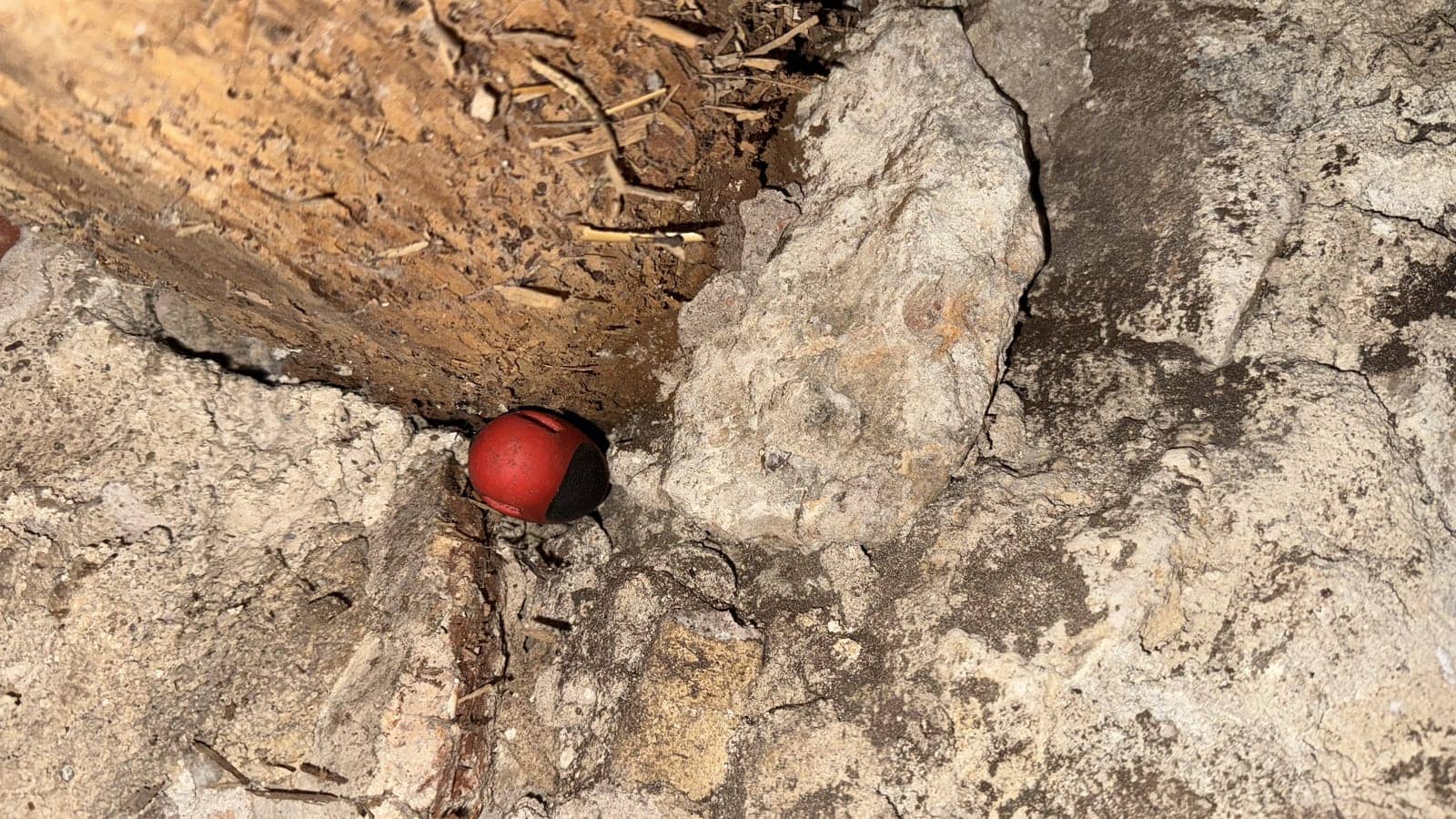
Fine, light frass under the beam
A small pile of dust the colour of fresh wood under a hole, reappearing days after you clean it. That is the activity marker. Holes alone can sit there for forty years without a single live insect left.
We listen to the wood before proposing anything: the beam with larvae inside is treated by pressure injection and the one that only holds old holes is documented and monitored.
Visual assessment visit included, at no cost and with no obligation. The technical study with audiotermes, which confirms every point of damage, is quoted separately and you decide with the figure in front of you. We work Monday to Saturday.
Request your no-obligation visual inspection
We reply within 24 hours.
We serve the provinces of Barcelona and Girona.
* Required fields
A hole in a beam in Roses does not prove the woodworm is still inside: it may be the exit of an insect that died decades ago. With so many inherited second homes, part of the enquiries we handle concern infestations that died out years ago and part concern larvae at work today. The difference is marked by fresh frass under the beam and by listening to the inside of the piece. Only wood with confirmed activity is treated by injection.
In the old town of Roses there are plenty of houses passed from one generation to the next with the original ceiling: beams nobody has replaced and which carry the marks of every occupant, insects included. Many of those holes are old exits, from woodworm populations that died out long ago. Others are recent. To the naked eye they look alike, and that is why the age of a hole is settled with more evidence than the eye.
Santa Margarida is another setting: houses on the canals, designed for the season, with joinery, mezzanines and wooden staircases nobody looks at between one summer and the next. A home opened only a few weeks a year has nobody to sweep up the frass or to notice a soft edge, so the sign waits months for the owner. The sea air, constantly damp, keeps that wood at the point the larvae prefer for working slowly.
In the housing estates climbing the hillside, with the Mas Fumats as the clearest example, the wood lives out in the open: porches, pergolas and terrace beams that get sea sun and dew almost daily. That cycle opens splits in the surface, and splits are doorways for egg-laying. An outdoor piece is examined differently: we look for frass gathered in sheltered corners, where the tramuntana has not swept it away before anyone sees it.
Telling an old hole from activity rests on repeatable evidence. Fresh frass is pale, rough to the touch and reappears after it is cleared away; old frass is caked and darkened. The edge of a recent hole is sharply cut; a veteran one is rounded and dirty. And when the eye cannot reach, amplified listening to the piece gives away the larvae gnawing inside. With confirmed activity we inject; without it, the beam is documented and monitored.
Zone by zone, what was built, what wood sits inside and where the insect gets in. It is the reading our technicians make before deciding where the check starts.
| Zone of Roses | Dominant construction | Wood present | Way in | First sign |
|---|---|---|---|---|
| the old town | Houses between party walls with inherited ceilings | Ceiling beams on the upper floors | Beams that never saw a preservative | New frass on top of old dust |
| Santa Margarida | Canal-side houses in seasonal use | Joinery, mezzanines and indoor staircases | Egg-laying in unvarnished joinery | Door edge that crumbles |
| el Mas Fumats | Hillside villas with outdoor wood | Porches, pergolas and terrace beams | Splits opened by sun and dew | Holes with a sharp, pale edge |
Source: ERRADICAT technical criteria from own work in the province of Girona · retrieved on 4 September 2026.
Almost everyone arrives looking at the holes, and the hole is the one thing that says nothing about activity. These three do.
A small pile of dust the colour of fresh wood under a hole, reappearing days after you clean it. That is the activity marker. Holes alone can sit there for forty years without a single live insect left.
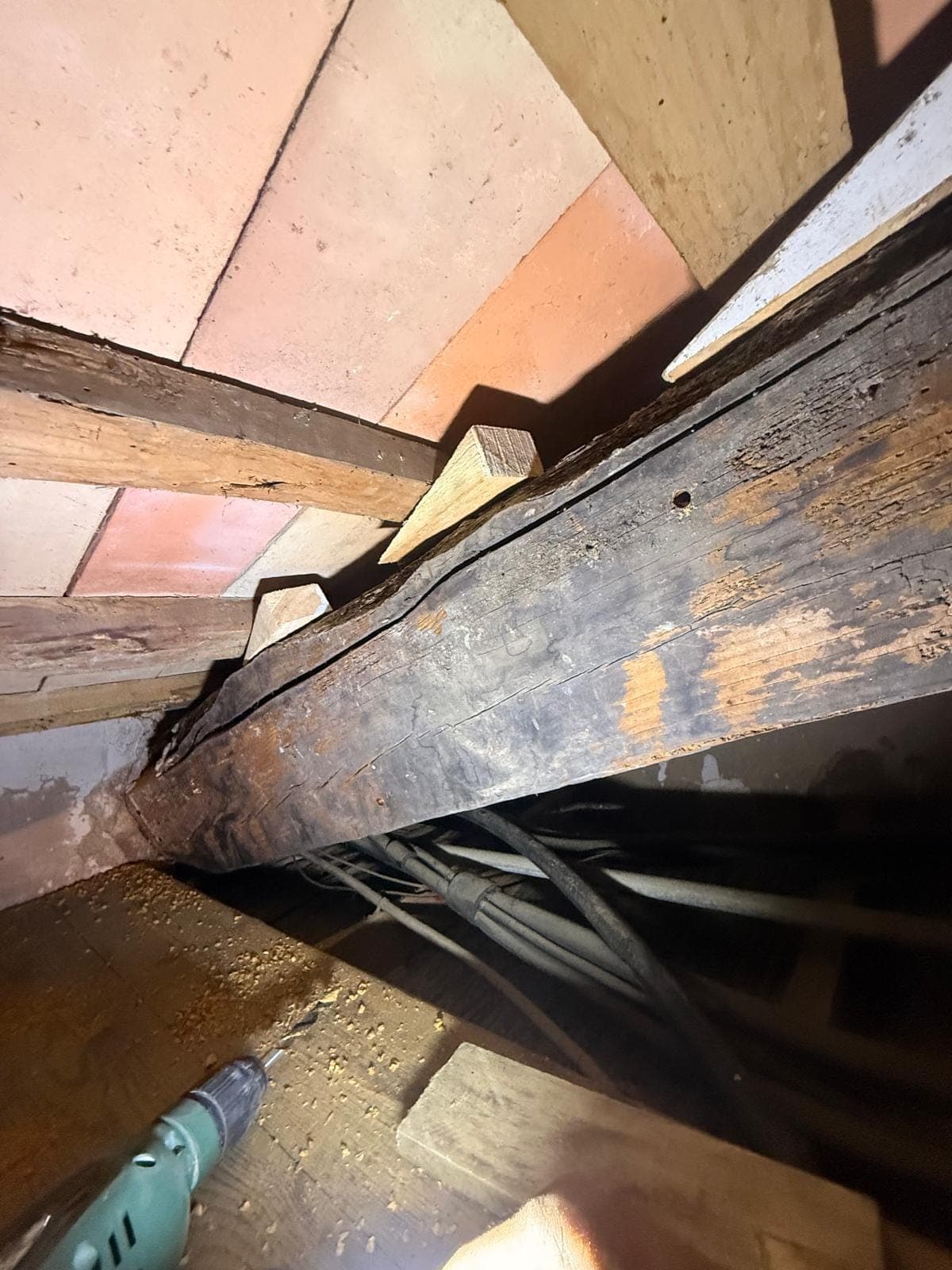
The diameter and shape identify the insect. Round and small points to common woodworm. Oval and several millimetres wide points to the longhorn beetle, the house borer that genuinely compromises a beam's section.
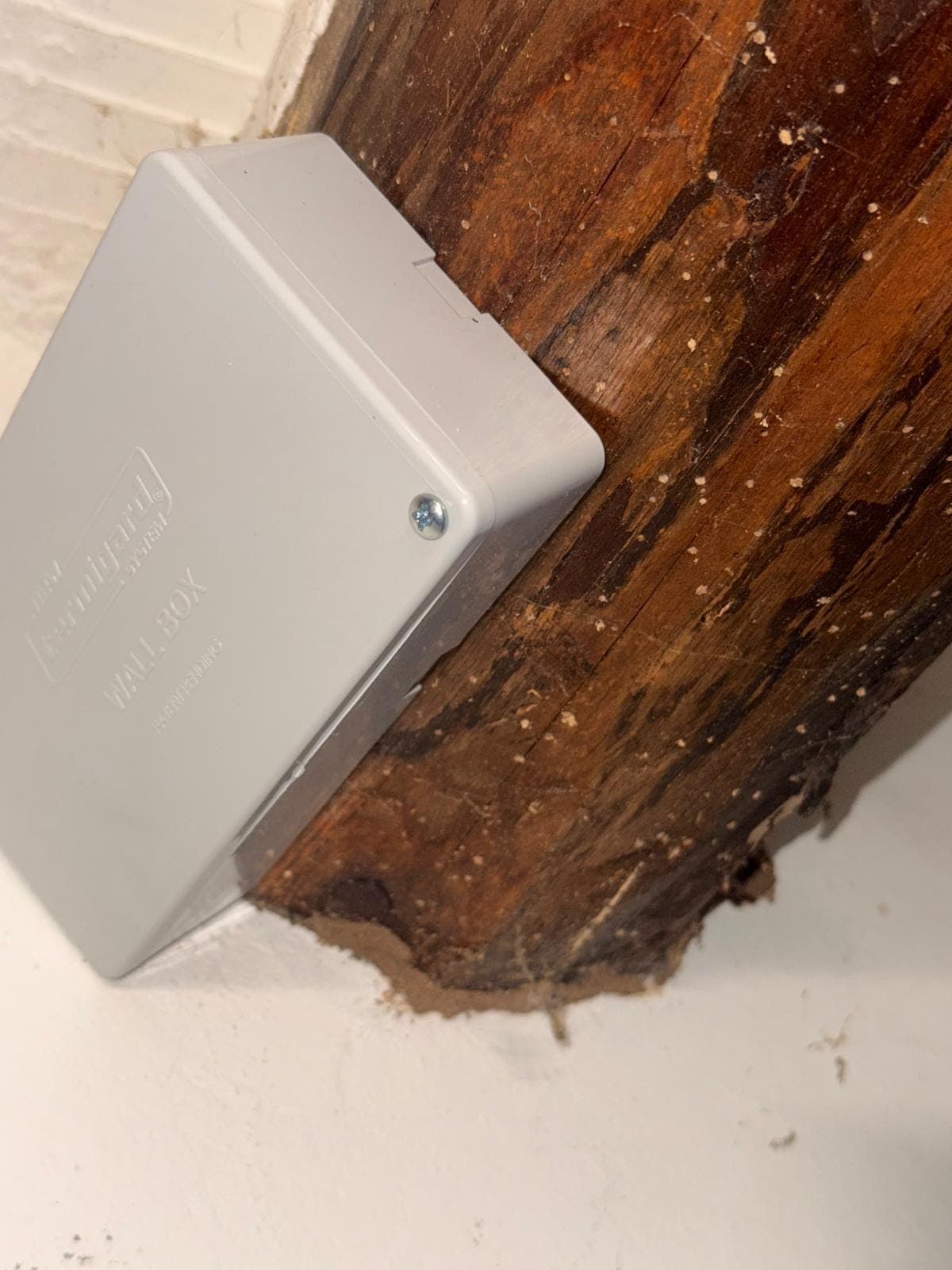
In a calm house, above all at night and in spring, you can hear a very fine scraping inside the wood. The audiotermes amplifies that sound and locates the exact piece, which is what makes it possible to treat where treatment is due.
In Roses the adult woodworm beetles emerge with the heat, and their clearest trace is not the insect but the freshly cut hole that appears in beams and pergolas when the house is opened in summer.
Common woodworm Anobium punctatum
Activity: from April to August · Peak: May and June.
House longhorn beetle Hylotrupes bajulus
Activity: from June to August · Peak: July.
These dates are indicative windows. Flight depends on temperature and humidity, so each year it starts earlier or later: if you see winged insects outside these months, it is still a reason for an inspection.
Source: Higiene Ambiental, technical journal of the sector · retrieved on 21 July 2026.
First the wood is read. Inspection with audiotermes, identification of the insect and assessment of whether the piece can take a curative treatment or has already lost load-bearing section and must be reported for replacement. If there is varnish, paint or limewash on top, it is stripped first: through a sealed coat the product does not get in.
Then comes the injection. Small-diameter holes are drilled at regular intervals, non-return valves are fitted and the wood preservative, a TP8-type biocide, is injected under pressure to reach the internal galleries. The UNE-EN 351 standard grades penetration from NP1 to NP6, and on a structural beam the target is the high classes, not a surface coat.
It closes with a double fumigation in two coats over the whole visible face of the piece, to cover what the injection cannot reach. And when the piece cannot be drilled, like a piece of furniture, a carving or a demountable coffered ceiling, there is anoxia: the piece is sealed in an oxygen-free atmosphere until the insect's cycle completes, without touching the finish.
Woodworm is solved on site, not over months of monitoring. The calendar depends above all on the metres of beam and on whether stripping is needed.
Total duration:Written assessment based on the measured wood; work organised by zones
Included
A naked-eye walk along the accessible wood to see the apparent extent. The assessment visit is included, at no cost and with no obligation, and it is the starting point when the signs are unclear.
1 working day, with the figure agreed first
Percussion sounding, listening with audiotermes, identification of the insect and piece-by-piece measurement of the linear metres of beam. We always recommend it: it confirms every point of damage and marks which pieces need treating. It is quoted separately, so you see it with the scope in front of you and it starts when you say yes.
A few days later
Floor-by-floor plan with every beam numbered, its damage and the treatment proposal with your written quote. The work is measured by linear metre of beam counted on site, not by square metre of home. It is part of the technical study.
Only if there is a coat on top
Manual removal of limewash, paint or varnish in the areas to be treated, without harming the wood. Without this step neither the inspection nor the product penetration is reliable.
By floor or by room
Drilling, fitting of non-return valves and pressure injection of the wood preservative into the galleries.
Same day as the injection
Two coats over the whole surface of the piece, including accessible faces and edges.
As per the product data sheet
Waiting time before reoccupying the room. It is stated in writing in the intervention report.
The visual assessment visit is included, at no cost and with no obligation: when the signs are unclear, it is the way to clear doubts. Even so, we always recommend the technical study with audiotermes, a floor plan of the issues found and a report, which is quoted separately: it confirms every point of damage, fixes where the treatment must act and from it comes your written quote, so you decide with the figure in front of you.
Source: ERRADICAT's intervention protocol · retrieved on 4 September 2026.
Not necessarily, and in Roses it is the most repeated doubt, given the weight of inherited housing. The hole is the exit of an adult and stays there for ever, so it may be two years old or sixty. What dates the problem is the rest of the signs: frass that returns after cleaning, freshly cut hole edges and, during the inspection, the sound of the larvae inside the wood. Without those signs, the piece is monitored, not treated.
Yes: in Santa Margarida the woodworm makes no distinction between a lived-in house and a shut one, because the larva lives inside the piece and keeps gnawing with the blinds down. What changes is the warning, which is delayed until the reopening. That is why it pays to spend the first hour of the season looking at the wood, the undersides of beams, mezzanines and door edges, before sweeping or airing: the undisturbed frass tells what has happened during the absence.
It is worth assessing it before deciding, and in the Mas Fumats that assessment is made on the piece, not on a photo. An outdoor beam with holes can keep almost all of its section sound; in that case injection with non-return valves protects it from inside and it stays in service. If the wood gives when pressed with a tool, the section is gone and the serious answer is to replace. The answer comes from checking every piece, not from counting holes.
Yes, and in the old town of Roses it is a common situation. A sealed varnish stops the preservative penetrating through the surface, so the working area is stripped first, with soft-abrasive blasting if the coat is hard. Then the non-return valves are fitted, the injection is done under pressure and the whole is finished off with double fumigation of the surface. The beam ends up treated inside and protected outside.
Yes: the woodworm guarantee is 1 year in writing and goes with the treated wood of the Roses house, not with the calendar of whoever lives in it. If new frass appears on a treated piece within that period, it is inspected and dealt with under the guarantee. One gesture that helps: leave the wood clean when closing up in September, so that any remains found on returning can be read without doubt.
In Roses we cover the whole municipal area, including the old town, Santa Margarida and el Mas Fumats, and we also reach Cadaqués, Castelló d'Empúries and Palau-saverdera. We work Monday to Saturday, 7:30 to 22:00.
Roses has l'Escala right opposite, across the bay, and its page tells of a different commission: a termite survey with the activity confirmed in frames and skirting boards.
Termite survey and treatment in l'Escala, piece by pieceRoses and Figueres share a comarca and a road, and the capital of the Alt Empordà has its own termite page, centred on buildings between party walls renovated in phases.
Termite treatment in Figueres, from the ground-floor shop to the renovated flatRoses shares its pest with Tamariu, over on the Baix Empordà coast: there woodworm shows in the exposed beams of the old fishermen's houses and is also treated by injection.
Woodworm treatment in Tamariu, from exposed beams to porch logsEach municipality has its own page, with real work from its area and the detail of how we work there.
Most popular municipalities
The ROESP is the Spanish official register of pesticide establishments and services. It is the legal requirement for applying professional-use biocides, and not everyone offering these treatments meets it.
The technician who signs the reports, Sergi Casadevall Casas, has been treating termites and woodworm in Barcelona and Girona since November 2011, holding the biocide applicator licence. Visits are always made by our technicians, never by salespeople.
The conditions and timescales go in the intervention report, signed. For termites, 3 years from the certificate of colony elimination, with the annual inspection included at no added cost.
The technical study ends in a floor-by-floor plan of the property, with the issues found marked and the real extent of the damage. It is quoted separately and the document stays in the owner's hands, to work with the architect or to seek a second opinion with data on the table.
Spanish Royal Decree 830/2010 establishes that a pest-control company's registration in one autonomous community is valid to work in the rest. That is why we cover both provinces with the same registration and the same team.
Content of this page reviewed by our technicians on 4 September 2026.
We ask what you have seen and where. If the signs are unclear, we book the visual assessment visit, which is included and takes little time. And when the signs are there, what we recommend is the technical study: audiotermes, a floor plan of the issues found and a report, with your written quote so you decide with the figure in front of you. If the wood is healthy, we tell you that too: you save yourself the treatment.
602 433 979The visual assessment visit is included, at no cost and with no obligation: when the signs are unclear, it is the way to clear doubts. Even so, we always recommend the technical study with audiotermes, a floor plan of the issues found and a report, which is quoted separately: it confirms every point of damage, fixes where the treatment must act and from it comes your written quote, so you decide with the figure in front of you.
We serve the provinces of Barcelona and Girona.
* Required fields