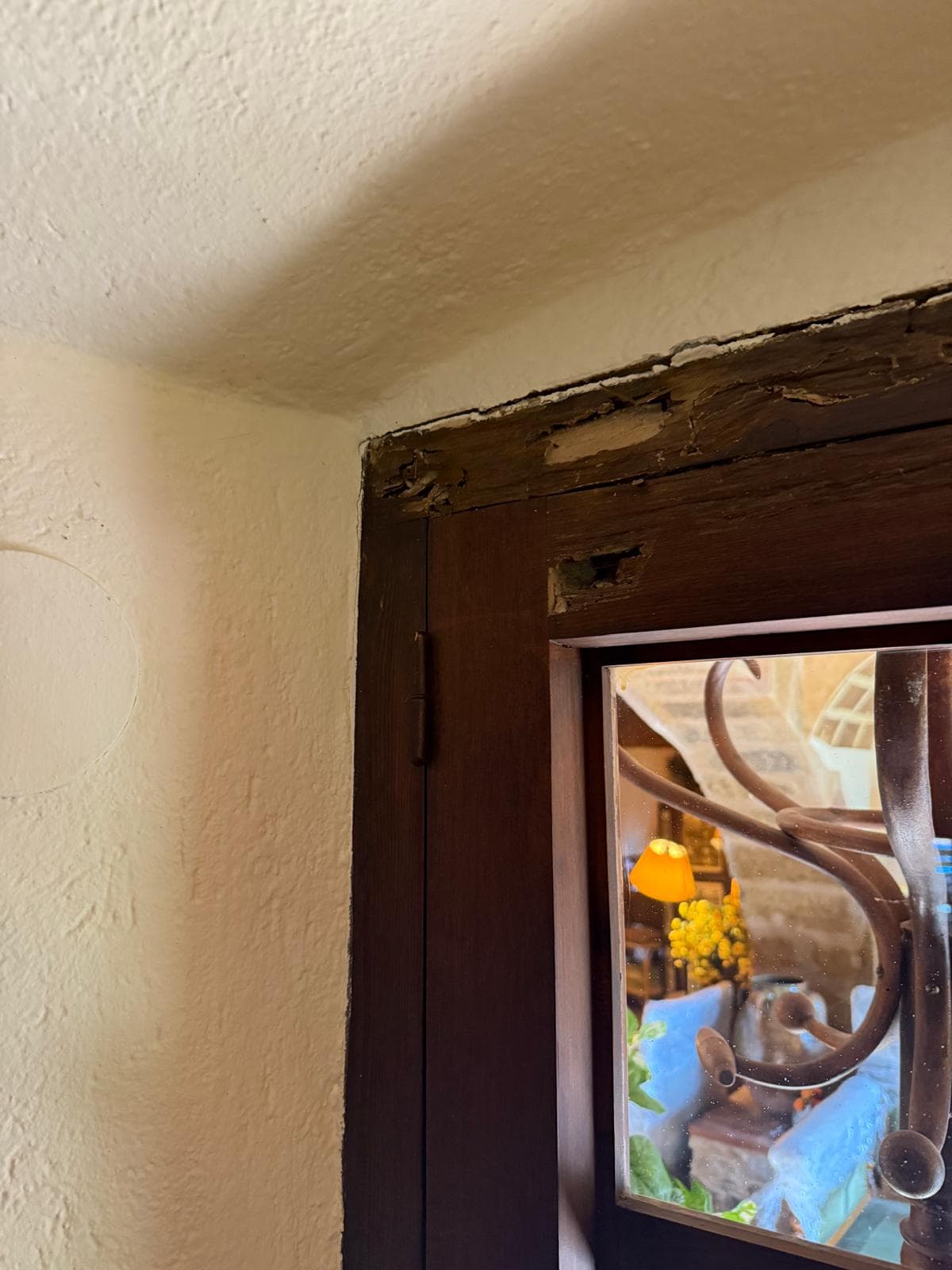
If you are about to renovate and you suspect there may be termites or woodworm in the timber, there is one golden rule: inspect before you touch anything. Renovating without a diagnosis first is the most expensive mistake we come across. Building work can scatter the termites for a while and leave the damage hidden behind the new cladding, so the problem drops out of sight but not out of the house, and it comes back worse a few months later.
Renovation and wood-boring pests go hand in hand
In Barcelona and Girona, plenty of renovations end up touching timber: beams, beam ends, brick vaulting, frames or parquet flooring. And old timber is exactly what the pest is after: more than 90% of buildings put up before 1920 have a timber structure (source: ANECPLA), and the subterranean termite (Reticulitermes spp.) is present in 80% of the country's municipalities (source: ANECPLA / IPNA-CSIC). A renovation is also the moment that timber ends up exposed, and the disturbance of the work (vibration, dust, swings in humidity) can turn the pest against you if you have not had it diagnosed first.
The costliest mistake: renovating without inspecting
When the time comes to renovate, it is tempting to treat the problem as already solved: to assume that covering the affected timber under the new cladding will do, or that anything cropping up mid-job can just be handled as you go. Both assumptions fail, and for different reasons depending on the pest.
Termites: the work scatters them and they come back hidden
The subterranean termite nests underground and climbs up through galleries to feed on timber. It is highly sensitive to disturbance: the vibration and upheaval of building work send the workers into retreat, so for weeks it can look as though there is nothing there, and an inspection carried out mid-renovation may hand you a false negative. Spraying insecticide "just in case" is worse still: repellents alert the colony and drive it to open galleries somewhere else, scattering the attack rather than wiping it out.
Once the work is done and the house settles again, the colony (still intact underground, hundreds of thousands strong) climbs back up, now behind the new plasterboard, the suspended ceiling or the parquet. The damage creeps on out of sight, and when it surfaces again you have to reopen what you have only just closed up: twice the cost, twice the work. We go into it in detail in our guide to the baiting system.

Woodworm: varnishing or covering the beam seals the problem in
Woodworm is the larva of wood-boring beetles, and it spends years inside the timber tunnelling galleries as it goes: the house longhorn beetle can spend up to 12 years eating away inside before it gives itself away (source: ITM Tratamientos de la Madera). Leave the beam exposed during the renovation and varnish or paint it without treating it first, and the finish will not kill the larva, it only seals the surface. Worse still, it later forces you to strip the wood before it can be treated, so it pushes up the cost of the eventual treatment.
Shop-bought products are no answer here either, because they work on the surface and never reach the galleries. Only pressure injection and a double fumigation get to the larva, as we explain in our guide to how to get rid of woodworm.
Not sure? Signs to check before you call
More often than not, people have no idea whether there is an infestation at all, and that is perfectly normal: the termite leaves next to no trace and woodworm does its work out of sight. The signs below will point you in the right direction, though they are no substitute for an inspection:
| What you see in the home | Usually points to | What to do |
|---|---|---|
| Mud tubes or tunnels on walls, foundations or beams | Subterranean termite | Inspect as soon as you can; do not chip at the area |
| Loose translucent wings near windows in spring | Termite swarm | Inspect as soon as you can |
| Sawdust or fine powder under beams and furniture | Active woodworm | Inspect; do not varnish over the top |
| Round holes 1 to 3 mm across in the timber | Common woodworm | Inspect before you renovate |
| Timber that sounds hollow or gives way when pressed | Advanced termite or woodworm | Inspect before you renovate |
| Frames or beams that crumble when you open up a partition | Hidden structural damage | Stop work and call the technician |
The practical takeaway is simple: when in doubt, inspect. It settles the question without breaking anything open, the visual inspection is free, and it keeps you from going into the work blind. If you would rather dig into it yourself first, we have the signs of termites and our guide to woodworm.
Our inspection and the three scenarios
Our inspection is built for exactly this stage, the point just before the renovation. It tells you what is there, where it is and what to do about it, with no destructive work involved. Here is how we do it:
- A plan of the whole home. We draw up a floor plan of the property and mark every relevant point on it, so everything is laid out clearly and easy to hand over to your architect or builder.
- Detection with AUDIOTERMES. We use a device that amplifies the sound termites make as they feed inside the timber. It picks out active colonies in beams, beam ends and joinery where there is nothing to see with the naked eye, without chipping into walls or taking structures apart. We round it off with a look over the exterior and a shallow test probe at the beam ends, a quick check at an accessible point that leaves the structure intact.
- A report covering every affected point. We hand you a report that sets out each affected area, the type of pest and the true extent of the damage.
- Where we would step in. The report shows exactly which points we would treat, and with which method, if any work turns out to be needed.
- A treatment quote, but only if it is needed. Fixed, in writing and with no obligation. If there is nothing to treat, there is no quote to hand you.

You pass that report and its plan to your architect or builder, and the job gets planned around what to treat, what to reinforce and what can safely be closed up. And an inspection has only three possible endings, and you come out ahead in every one:
| Inspection result | What it means, and what you do about the renovation |
|---|---|
| Confirmed activity | You know exactly what to treat and where. We line the treatment up with your renovation in the right order, so the work neither buries it nor ruins it. You have dodged the worst case of all: sealing up a wall over a living infestation. |
| Old damage, no live infestation | The report makes it plain: if the damage is old and the timber is weakened but nothing is active, you do not pay for a treatment you do not need, and you renovate with a clear head, reinforcing or replacing only what is genuinely compromised. |
| There is nothing | Green light. We give you a report that certifies it, and you start the renovation with a clear mind, with no nagging doubt halfway through the job. |
None of them leaves you worse off: either you head off an expensive problem, or you renovate with a clear conscience. The one thing you should never do is dive into the work without knowing which of the three you are looking at.
The right order and your checklist
If treatment does turn out to be needed, the order still matters. With termites, the baiting system is non-destructive and sits happily alongside the work: the stations are checked every 6 to 8 weeks, and the colony is wiped out over 6 to 12 months as the renovation carries on around it. With woodworm, the treatment has to come before the finish: the wood is stripped if it has been varnished, then pressure-injected and given a double fumigation (TP8), and only after that is it varnished or closed up. One rule sums it all up: treat the timber before you give it its final finish, never the other way round.
Before the first swing of the hammer, run through this:
- Is there timber involved? Beams, frames, parquet. If the answer is yes, you are in at-risk territory.
- Can you spot any signs? Sawdust, holes, mud tubes, loose wings or hollow-sounding timber: inspect first.
- Do not spray insecticide "just in case": you scatter the colony and throw off the diagnosis.
- Do not varnish or paint untreated timber: you seal the problem in and push up the cost of treating it.
- Ask for the inspection, with report and plan, before you pin down timings and budget with the builder.
Five minutes of checking now saves you opening the same wall twice.
Conclusion: diagnosis first, then the work
A renovation is the best chance you will ever get to leave the timber in your home sound for decades, and at the same time the worst possible moment to paper over a problem without looking at it. The termite does not pack up and leave because the builders arrive: it hides, then comes back. Woodworm does not die because you varnish it: it carries on eating underneath. The one route that never turns against you is a diagnosis up front.

At ERRADICAT our technicians have 15 years of experience treating timber across Barcelona and Girona: a company on the ROESP register, holding a biocide applicator's licence (Reglamento UE 528/2012) and working only with products authorised by the Ministry of Health. Before you start your renovation, ask for a no-obligation visual inspection: if needed we quote the AUDIOTERMES detection with its report and plan, and from that survey comes the quote for what your timber needs, and in what order.