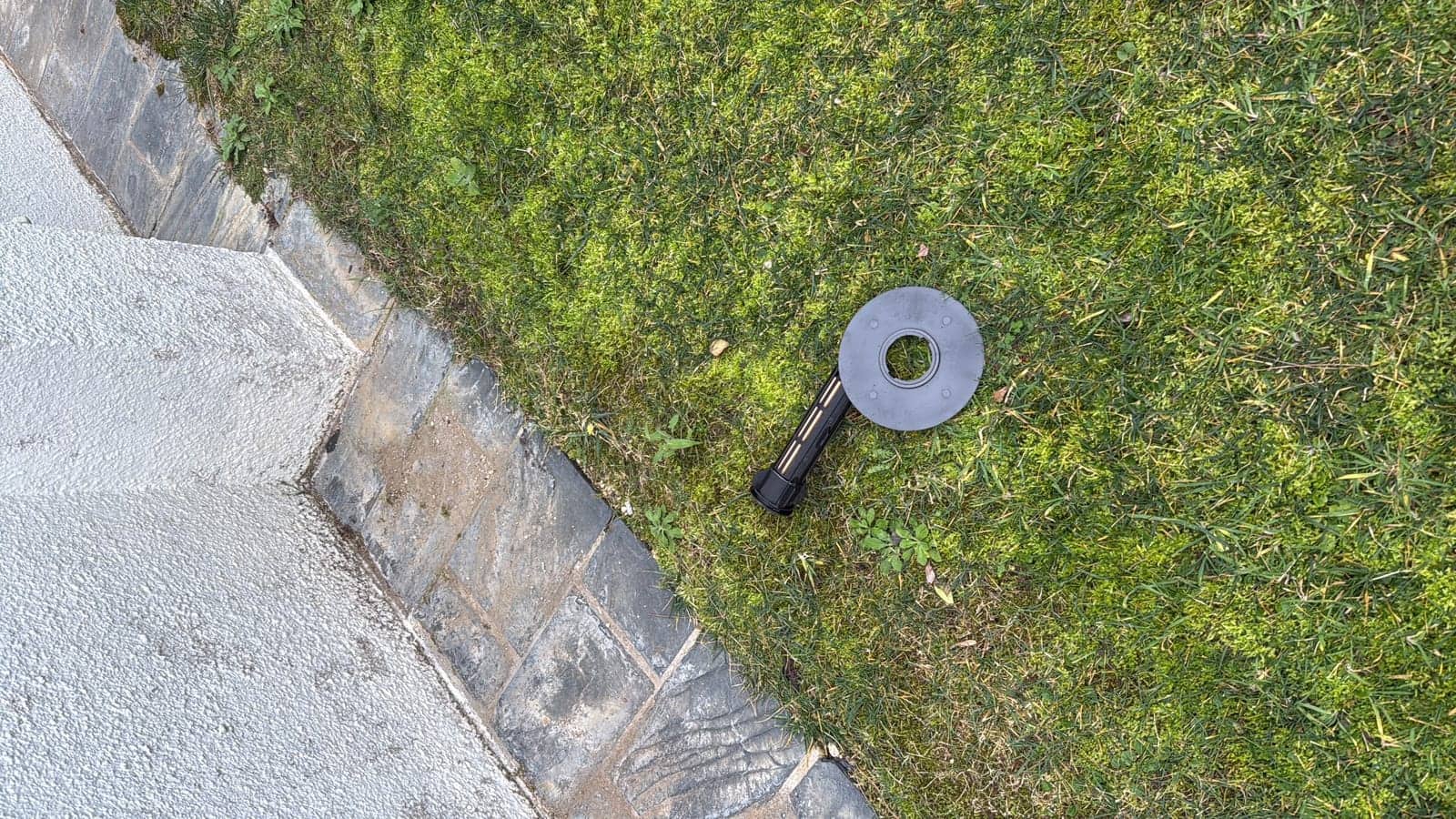
If you are looking for an eco-friendly termite treatment, you want two things at once, to get rid of the pest and to use as little product as possible. Science has a clear answer. Home and natural remedies kill the termites they touch, but not the colony, which lives underground. The only approach that needs no product at all is prevention, and once the colony is at work, the baiting system is the method that eliminates it with the least active ingredient and without injecting insecticide into the ground.
What to check before you trust an eco-friendly treatment
Eco is a label that gets used a lot and explained very little. With termites, you can judge any method by four questions, the same ones our technicians ask themselves before deciding how to act.
- Does it eliminate the colony or only the termites you can see? A remedy that never reaches the nest has to be applied again year after year, and every repeat means more product and more lost timber.
- How much active ingredient does it need? Half a gram is not the same as hundreds of litres of solution injected into the ground.
- Where does the product end up? Inside a closed station that gets checked, or spread through the soil, the walls and the timber of the house.
- How much drilling does it take? Drilling through floor slabs and foundations every 30 centimetres is an impact too, and you notice it in the house.
Put these four questions to them and almost every natural remedy fails the first one. The classic chemical barrier fails the second, the third and the fourth.
Why the colony decides what works
In Catalonia, genetic studies identify the subterranean termite as Reticulitermes banyulensis, a native species (Lefebvre and colleagues, 2016). Its nest is not in the damaged beam you can see. It is in the ground, and from there the workers build galleries and mud tubes up to the timber. According to the public health factsheet from the Barcelona Provincial Council (Diputació de Barcelona), a colony numbers from 200,000 to more than two million individuals, which forage over areas of 18 to 2,300 square metres and up to 70 metres from the nest.
Three features of its biology explain why almost every remedy fails.
- They work far from where you see the damage. What shows in a skirting board or a beam is just a fraction of the colony. The rest stays underground, out of reach of any contact product.
- The queen can be replaced. If the founding pair dies, other termites in the colony turn into replacement reproductives and carry on laying eggs (Gaju Ricart and colleagues, 2015). Killing a few of them, or even the queen, is not enough.
- They share food mouth to mouth. In the lab, marked food passed from worker to worker in just 6 to 12 hours (Suárez and Thorne, 2000). That sharing, known as trophallaxis, is the door through which a bait reaches the whole colony, and the one a contact product never opens.
The other termite in the area, the drywood termite (Kalotermes flavicollis), lives inside the piece of timber itself in colonies of 1,000 to 1,500 individuals and is dealt with differently.

Home remedies to get rid of termites, one by one
The internet is full of recipes. A 2022 review found that the first Pinterest search for remedies returned 23 recommendations with no efficacy data at all (Oi, 2022). Here is what published research says about the most searched-for ones.
| Remedy | What the research says | Why it does not wipe out the colony |
|---|---|---|
| Vinegar | Pure acetic acid kills termites in a sealed lab dish (Yatagai and colleagues, 2002). But wood soaked in 25% acetic acid, about four times stronger than kitchen vinegar, killed no more termites than wood treated with plain water (Telmadarrehei and colleagues, 2020). | There are no published trials with kitchen vinegar, which evaporates, barely soaks into the wood and never reaches the nest. |
| Orange oil | Its vapours killed up to 96% of the termites inside a sealed container, but in a mock-up wall they caused hardly any deaths (Raina and colleagues, 2007). | In sand, the amount of its active compound plummeted within three weeks. It needs an enclosed space that the soil does not offer. |
| Neem | When fed neem bark, termites ate less and more than half of them died in the lab (Delate and Grace, 1995). | We have not found a single field trial in which neem eliminates a colony. |
| Boric acid | It kills when they eat it and pass it among themselves (Grace, 1991). As a bait, poisons of this type reduce activity but leave termites still foraging (Su and Scheffrahn, 1998). | In the soil it does not stop them, because termites tunnelled through sand containing 5,000 to 15,000 ppm of borates. On top of that, the European Union classifies it as toxic for reproduction. |
| Diatomaceous earth | When dry, it kills by dehydration in the lab, and in damp conditions it loses much of its effect (Gao and colleagues, 2018). | The subterranean termite lives in damp soil, and in the trial it crossed layers 1 and 2 millimetres thick. |
| Wet cardboard trap | It draws workers in because it is damp cellulose. Researchers have used it for decades to monitor and collect termites (Grace, 1989). | It removes workers, but the reproductives stay underground and the colony replaces them. |
The same pattern repeats with all of them. They act where they are applied and only for a short while, as the colony carries on eating wood somewhere else. If you have already seen mud tubes, loose wings by a window or wood that sounds hollow, go over the warning signs of termites in the home first.
What smell do termites hate?
In lab trials, the smell that repels them most is vetiver oil, above all because of its main component, nootkatone. Vetiver held back termites in treated sand for the full three weeks of the trial (Maistrello and colleagues, 2001), and in treated wood nootkatone kept its effect for up to twelve months (Maistrello and colleagues, 2003). Clove oil was the most toxic of the eight oils tested and killed every termite within two days on contact (Zhu and colleagues, 2001). The cedar component that was tested did not hold them back.
There are two important caveats. All of those trials used an Asian subterranean termite, the Formosan termite, which does not live in Catalonia. And a smell diverts the workers but does not eliminate the colony, which goes on foraging elsewhere. It helps you understand the termite, not get rid of it.
Fungi and nematodes, the biological control that never reaches the nest
Using the termite's natural enemies is an appealing idea. The fungi Metarhizium anisopliae and Beauveria bassiana, or nematodes of the genera Steinernema and Heterorhabditis, kill termites easily in a lab dish.
In the field it is a different story. A review of fifty years of research concluded that biological control has not produced a single effective commercial method against termites, and that many promising lab results were not borne out in practice (Chouvenc, Su and Grace, 2011). In one trial with Metarhizium, 90% of the treated termites died, but the fungus did not spread to the rest of the colony within 90 days (Chouvenc, Su and Elliott, 2008). The reason is the colony's social immunity (Chouvenc and Su, 2012).
- Workers groom one another and remove the spores before they germinate.
- They bury their dead nestmates or eat them, so the fungus never completes its life cycle.
- The workers' gut holds back the spores they swallow.
- They steer clear of areas with infected corpses.
Something similar happens with nematodes. In a dish it takes hundreds per termite to kill half of them, and one of the species tested did not affect the subterranean termite even at 2,000 per termite (Wang, Powell and Nguyen, 2002). Today biological control is still a line of research, not a treatment for a home.
Baits, grams instead of litres
The baiting system puts that same biology to work. Instead of taking the product to the termite, it lets the termite carry it to its colony. A station holding cellulose, the food they are after, is placed at the points with activity. The workers eat the cellulose and share it through trophallaxis. A termite that eats the bait dies when it tries to moult, because it cannot form its new cuticle, and before moulting it goes back to the heart of the nest, alongside the brood and the reproductives (Su, 2019; Chouvenc, 2025). Death comes slowly, and that gives the bait time to work its way through the whole colony.
The difference in quantity is enormous. A review of 100 studies in 16 countries concluded that a baiting system uses around half a gram of active ingredient per colony (Evans and Iqbal, 2015). A chemical soil barrier needs hundreds of litres of insecticide solution, injected into a trench along the foundations and into holes drilled through the slab (University of Kentucky). What is more, the barrier protects while it lasts, but it does not eliminate the colony living outside (Su and Scheffrahn, 1998).
There is data from Spain too. In five town centres in Andalusia and Gipuzkoa, between 58 and 190 grams of active ingredient were enough to eliminate every colony detected within 7 to 16 months, and no activity was recorded for more than ten years afterwards (Mora and Hernández-Teixidor, 2025). The Spanish Technical Building Code (CTE) includes the method. For a termite attack found during a refurbishment, it asks for barrier treatments or baiting systems "intended to eradicate the colony" to be considered (DB SE-M, section 3.2.1.3.4).

At ERRADICAT we place the bait stations at the points where AUDIOTERMES detection confirms activity, inside and outside the house, check them every 6 to 8 weeks and top up the bait according to the consumption we measure at each visit. The treatment lasts between 6 and 12 months, until the colony is declared eliminated, and the guarantee is 3 years in writing from the certificate of colony elimination, with an annual inspection included. You will find the full step-by-step in our guide to the baiting system for getting rid of termites.
Prevention with no product, the greenest option of all
The subterranean termite needs moisture and usually gets in through timber that touches the soil (University of California). Take those two things away and you cut the risk without using a single gram of product.
- Keep damp in check. Fix leaks, send water from downpipes and irrigation away from the foundations, and ventilate cellars and underfloor voids.
- Keep timber off the soil. Under the Technical Building Code, timber in contact with the ground is use class 4 and needs deep preservative treatment. In the garden, leave about 15 centimetres of wall visible between the soil and the facade cladding so it can be inspected (University of Florida).
- No firewood or scrap timber against the walls. Forgotten planks, stacked firewood, stumps and dead trees are food and shelter right next to the house, as the Barcelona Provincial Council points out.
- Stay alert from April to June. That is when the subterranean termite swarms in the province of Barcelona. A swarm of winged termites or mud tubes on a wall are the clearest signs that there is a colony nearby.
- Physical barriers in new builds. A fine stainless steel mesh or a layer of precisely sized gravel blocks the way in without any product. The basalt barrier has been part of Honolulu's building code since 1989 (Grace and Yates, 1999). These barriers work if they are installed without flaws, and they are no use against a colony that is already inside.

When to call in a technician
If you see mud tubes on walls or skirting boards, loose wings by the windows or wood that sounds hollow, the colony is already at work. The subterranean termite advances out of sight, and the damage usually goes unnoticed until it is already extensive (Mora and Hernández-Teixidor, 2025). The first step is to find out where the activity is, before spending money on remedies. You have two options, depending on how clear things look to you.
- The visual assessment visit is included and is there to settle any doubts when there are no clear symptoms.
- The technical study with AUDIOTERMES, the one we always recommend, confirms every affected point, pins down where the stations go and comes with your written quote.
We come to your home anywhere in the provinces of Barcelona and Girona. Take a look at our full termite treatment and at the pages on termites in Barcelona and termites in Girona.
Scientific sources consulted
Every fact in this guide comes from peer-reviewed studies, official documents or university extension services.
See all 33 sources
- Chouvenc, T. (2025). How do termite baits work? Implication of subterranean termite colony demography on the successful implementation of baits. Journal of Economic Entomology, 118, 997-1007.
- Chouvenc, T. and Su, N.-Y. (2012). When subterranean termites challenge the rules of fungal epizootics. PLoS ONE, 7, e34484.
- Chouvenc, T., Su, N.-Y. and Elliott, M. L. (2008). Interaction between the subterranean termite Reticulitermes flavipes and the entomopathogenic fungus Metarhizium anisopliae in foraging arenas. Journal of Economic Entomology, 101, 885-893.
- Chouvenc, T., Su, N.-Y. and Grace, J. K. (2011). Fifty years of attempted biological control of termites. Analysis of a failure. Biological Control, 59, 69-82.
- Culliney, T. W. and Grace, J. K. (2000). Prospects for the biological control of subterranean termites, with special reference to Coptotermes formosanus. Bulletin of Entomological Research, 90, 9-21.
- Delate, K. M. and Grace, J. K. (1995). Susceptibility of neem to attack by the Formosan subterranean termite, Coptotermes formosanus Shir. Journal of Applied Entomology, 119, 93-95.
- Diputació de Barcelona, Salut Pública. Tèrmits. Official public health factsheet.
- Evans, T. A. and Iqbal, N. (2015). Termite (order Blattodea, infraorder Isoptera) baiting 20 years after commercial release. Pest Management Science, 71, 897-906.
- Gaju Ricart, M., Bach de Roca, C. and Molero Baltanás, R. (2015). Orden Isoptera. Revista IDE@ SEA, 49, 1-17.
- Gao, Y. and colleagues (2018). Bioactivity of diatomaceous earth against the subterranean termite Reticulitermes chinensis Snyder. Environmental Science and Pollution Research, 25, 28102-28108.
- Grace, J. K. (1989). A modified trap technique for monitoring Reticulitermes subterranean termite populations. The Pan-Pacific Entomologist, 65, 381-384.
- Grace, J. K. (1991). Response of eastern and Formosan subterranean termites to borate dust and soil treatments. Journal of Economic Entomology, 84, 1753-1757.
- Grace, J. K. and Yates, J. R. (1999). Termite resistant construction and building materials. Proceedings of the 3rd International Conference on Urban Pests, 399-406.
- Lefebvre, T. and colleagues (2016). Subterranean termite phylogeography reveals multiple postglacial colonization events in southwestern Europe. Ecology and Evolution, 6, 5987-6004.
- Lewis, V. R. and Haverty, M. I. (1996). Evaluation of six techniques for control of the western drywood termite in structures. Journal of Economic Entomology, 89, 922-934.
- Lewis, V. R., Haverty, M. I. and Sutherland, A. M. (2014). Subterranean and Other Termites. Pest Notes 7415. University of California.
- Maistrello, L., Henderson, G. and Laine, R. A. (2001). Efficacy of vetiver oil and nootkatone as soil barriers against Formosan subterranean termite. Journal of Economic Entomology, 94, 1532-1537.
- Maistrello, L., Henderson, G. and Laine, R. A. (2003). Comparative effects of vetiver oil, nootkatone and disodium octaborate tetrahydrate on Coptotermes formosanus and its symbiotic fauna. Pest Management Science, 59, 58-68.
- Ministerio de Fomento (2019). Documento Básico SE-M Seguridad estructural Madera. Código Técnico de la Edificación.
- Mora, D. and Hernández-Teixidor, D. (2025). Large-scale elimination of subterranean termite colonies of the genus Reticulitermes from town centers in Spain. Journal of Economic Entomology, 118, 982-996.
- Oi, F. (2022). A review of the evolution of termite control. A continuum of alternatives to termiticides in the United States with emphasis on efficacy testing requirements for product registration. Insects, 13, 50.
- Oi, F. M. and colleagues. Termite Prevention and Control. ENY-2044. University of Florida IFAS Extension.
- Potter, M. F. (2026). Termite Control. Answers for Homeowners. ENTFACT-604. University of Kentucky.
- Raina, A. and colleagues (2007). Effect of orange oil extract on the Formosan subterranean termite. Journal of Economic Entomology, 100, 880-885.
- Real Decreto 830/2010, de 25 de junio, por el que se establece la normativa reguladora de la capacitación para realizar tratamientos con biocidas. BOE n.º 170.
- Su, N.-Y. (2019). Development of baits for population management of subterranean termites. Annual Review of Entomology, 64, 115-130.
- Su, N.-Y. and Scheffrahn, R. H. (1998). A review of subterranean termite control practices and prospects for integrated pest management programmes. Integrated Pest Management Reviews, 3, 1-13.
- Suárez, M. E. and Thorne, B. L. (2000). Rate, amount, and distribution pattern of alimentary fluid transfer via trophallaxis in three species of termites. Annals of the Entomological Society of America, 93, 145-155.
- Telmadarrehei, T. and colleagues (2020). A study of the gut bacterial community of Reticulitermes virginicus exposed to chitosan treatment. Insects, 11, 681.
- Tuma, J., Eggleton, P. and Fayle, T. M. (2020). Ant-termite interactions. An important but under-explored ecological linkage. Biological Reviews, 95, 555-572.
- Wang, C., Powell, J. E. and Nguyen, K. (2002). Laboratory evaluations of four entomopathogenic nematodes for control of subterranean termites. Environmental Entomology, 31, 381-387.
- Yatagai, M. and colleagues (2002). Termiticidal activity of wood vinegar, its components and their homologues. Journal of Wood Science, 48, 338-342.
- Zhu, B. C. R. and colleagues (2001). Evaluation of vetiver oil and seven insect-active essential oils against the Formosan subterranean termite. Journal of Chemical Ecology, 27, 1617-1625.